- Date
- Itinerary
- Includes
- Not Included
- Gallery
Self driver and Land tour – 6 days / 5 nights
PRICE AND DATE ON REQUEST
Free departures
HOTEL 4 STARS
The hotel occupies an early 20th century building in the center of Rome, a 10-minute bus ride from St. Peter’s Basilica, Castel Sant’Angelo and the Vatican Museums.
The classic or modern design rooms have carpeted or parquet floors, free WiFi, LCD TV with satellite channels and, in some cases, a balcony overlooking Rome.
A buffet breakfast with homemade cakes and pastries awaits you, and at the restaurant you can enjoy typical Roman cuisine. During the summer, bar service is available on the panoramic terrace with a splendid view over the city.
Tour organize from Top One tour operator
Request to booking@top-one.it
Thanks to our services you can complete the organization of your trip and also book your flight, transfer from the airport to your hotel or car hire.
SEARCH AND BOOK FLIGHT
RESERVE TRANSFER
SEARCH FOR CAR HIRE
The Gardens Lazio tour
 ITINERARY
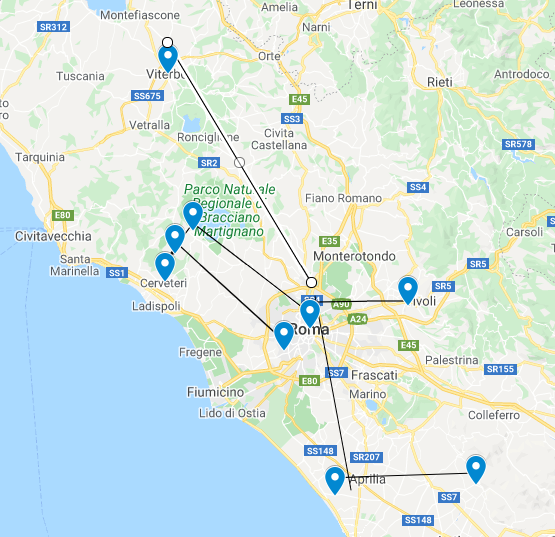
1st day Rome
Arrival at Fiumicino airport and private transfer to a 4-star hotel in the center of Rome
Day 2 Nymph and Landriana Gardens
Day trip with your vehicles to Ninfa and Landriana Gardens (entrance fees not included)
This private garden was purchased by the current owners in 1950 and designed by the English landscape architect Russel Page. Since the 1950s the garden has been enlarged and additional garden rooms have been added to by the owner, who is a passionate horticulturist himself. Among the 30 garden rooms we find a unique mix of both English style combined with Mediterranean plants and typically Italian style geometric gardens with citrus and other native plants. The gray and pastel plants, the characteristics of the water and the gravel and gray stone paths make this garden one of the most harmonious and peaceful gardens in Lazio. Free lunch at La Landriana,
Afternoon: visit to the Ninfa Gardens
The gardens and ruins of Ninfa have become world famous for the restoration works carried out by the Caetani family and, in particular, by Livia Caetani. The structure has been owned by the Caetani family since 1294, but the gardens and buildings have been repeatedly destroyed in territorial battles. The area was also abandoned in the past due to the abundance of water that brought malaria with it. Since the 1800s when the family returned to the area to drain the swampy land and create their home in Ninfa, expansion began to restore the property and create on the most important English-style gardens in Italy. The eight-acre park has nineteen different species of decidous magnolia, a collection of English roses that cover the ruins and trees and overlook the flower bed. Due to the unusual climate, Ninfa also has exotic plants such as avocados and banana trees. But it is the dreamy atmosphere of the ruins delicately draped in climbing roses and soft English landscape style that make this garden truly remarkable.
Day 3 Orchid and Villa d ‘Este Collection
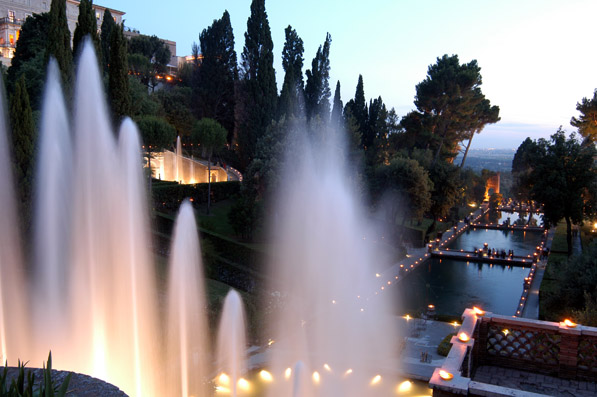
Private visit of the orchid collection of the Municipality of Rome. Time available for lunch, then you will drive to Villa d’Este in Tivoli – Villa d’Este is a masterpiece among the Italian gardens,
inserted as it is on the UNESCO World Heritage List with the impressive concentration of fountains, nymphaeums, caves, water games and water music. The imposing buildings and the terraces above terraces are reminiscent of the hanging gardens of Babylon. The Republic of Italy recently purchased the property and brought it back to its former glory. Return to the hotel in Rome
Day 4 Bracciano, Giuliano Castle, San Liberato, Ruspoli Castle
Day trip to the Giuliano Castle
The gardens of Castel Giuliano are a spectacular showcase for hundreds of varieties of roses. The park is the site of ancient Etruscan settlements then Roman. The owners recently decided to restore the Castel ruins and park in their former glory. The gardens extend from the Castle and occupy a large portion of the Park, which evolves in style from formal to landscaped garden: it begins by joining the architectural structures, then merging with native Mediterranean scrub. In May, the gardens host an annual Rose fair.
San Liberato
In the spring of 1964, when Russell Page’s first set eyes in this position of breathtaking beauty exclaimed: “I don’t know of any other garden capable of emanating the magic of San Liberato ago.” Over the next 10 years the page and his wife of owner Maria Odescalchi would have poured their efforts into creating these spectacular gardens. A real botanical park that contains Canadian maples, Japanese cherries, Spanish firs, Persian liquidambar and perrotias, camphor and tulip trees, as well as wild nyssas. San Liberato is even a rose garden, better, a gallery of roses, decorate the streets and structures throughout the garden.
Ruspoli Castle
The medieval Castel was transformed in the 16th century by the Farnese family into the suggestive Castel, which we see today. In 1611 Ottavia Orsini had the terraced gardens created including the vegetable garden, the secret garden, and the large woods used for
hunting. The intricate vegetable garden has taller hedges surrounding a parterre of lower boxwood plants. The garden has been so well preserved due to the fact that the family of origin still owns the property and has passed their gardening techniques over the centuries. Return to the hotel in Rome.
Day 5 Viterbo, Moutan Botanical Center, Villa Caprarola, Villa Lante in Bagnaia
In the morning day trip to the Gardens of Viterbo Moutan Botanical Center
The Moutan Botanical Center is a garden that boasts one of the richest and most complete collections of Chinese peonies in the world. It is a 15 hectare property entirely cultivated with Chinese shrub peonies: a unique collection, with very rare specimens belonging to different botanical and cultivated species, natural hybrids (cultivars) which in many cases are not found anywhere else in the world. The best time to see the spectacle of this blooming garden is the period from April 10th until the end of May.
Villa Caprarola
The entire complex of Villa Farnese in Caprarola was designed by the architect Jacopo Barozzi da Vignola, commissioned by Cardinal Alessandro Farnese. The gardens of the villa are as impressive as the building itself, a significant example of the Italian Renaissance garden period. The villa’s fortress theme takes place across from a surrounding moat and three. Two facades of the pentagonal arrangement face the two gardens carved into the hill; Each garden is accessed through the moat with a drawbridge from the apartments on the upper floor of the Villa and each is a formal parterre garden of the boxwood topiary with fountains. A walk through the chestnut wood beyond, you enter the secret garden with its well known casino.
Two of the most famous water features of this garden are “The Fountain of Satyrs” and “The Fountain of Venus emerging from the sea” Villa Lante in Bagnaia conceived as the summer residence of the bishops of Viterbo, was built between the 16th centuries and 17th at the behest of Cardinal Raffaele Riario, nephew of Pope Sixtus IV, of the Della Rovere family. In 1566 Cardinal Gian Francesco De Gambara, fascinated by the place, commissioned a new project by the famous architect il Vignola, creator of the gardens of Villa Farnese in Caprarola. The gardens of Villa Lante to those in Caprarola feature a cascade of dripping fountains and caves. Villa Lante and Villa Farnese belong to a period of Italian garden design which is considered one of the most important. project ideas are drawn from previous projects. The geometry was inspired by the Belvedere in the Vatican; the use of water by the Villa d’Este; the circular island echoes ‘marine theater’ of Hadrian in Tivoli and the islets at Boboli. They are the sum of the important history of Italian garden design from the Roman to the Renaissance periods. Return to the hotel in Rome
6th day Departure for the return.
5 nights in a double room in a **** hotel with breakfast in a hotel in central Rome
The journey to the meeting places and back. Lunches and dinners / Drinks with meals. Visits and entrances
Extras generally of a personal nature
Everything not specified under the item “the price includes”
On demand
naturist guide for single visit